Monday Musings: Part 2: Visualize Your Dream Writing Life

You can find the first post in the series here: Monday Musings: LOA for Writers

Every bestselling novel began as an idea in someone’s mind. Many people don’t get beyond the idea. Your writing career can begin the same way but better — with clarity and visualization.

Let’s take a look at the numbers.
The odds of you finishing the writing of and publishing you book are often quoted as follows:

  • Only 3% of people who set out to write a novel actually finish a novel. To put that into context, the USA (pop 332M) is about 4% the population of the world (8B).
  • Less than 0.1% of people ever write a book, so we’re down from a worldwide population of 8B to 8M. That’s equivalent to New York City. It’s still a lot of people, but think of it like this: in the entire world, 7,992,000,000 will never write a single book.
  • The odds of getting a book traditionally published is around 1-2%.
  • The average traditionally published book sells around 3,000 copies over its lifetime, and less than 500 the first year.
  • A PUBLISHER breaks even on a $10,000 advance by selling around 1,000 copies. There are a lot of variables at play here, but an AUTHOR earns out on a $10,000 advance by selling more than 5,000 copies. Less than 25% of books “earn out” their advance.
  • What about best sellers? These numbers are clouded in secrecy but one estimation is that a book has to sell at least 10,000 copies during the FIRST WEEK to even have a shot at the NYT Best Seller list. Something like 0.08% of books published in the US annually (300,000) make the US Best Seller lists. To break this down, you have a better chance of winning the lotto (1 in 300M) and being struck by lightning twice (1 in 9M) than writing a book, getting it traditionally published, and making the Best Sellers list.

Sound discouraging? It shouldn’t. If you’ve finished a book you may already be in an elite class of only 3% of all the people who start a novel and actually finish it. If you’ve been traditionally published you may already be breathing even more rarified air.

Even so, almost any author will tell you that every book feels like writing for the first time. Many of us call it “imposter syndrome”. This is where visualization comes in. Visualization is mental rehearsal. When you picture your ideal writing life, your mind treats it as reality, preparing you for opportunities and because your mind treats all input as true, negative visualizations can bring negative influences, let these pass on by. They’re not for you.

There’s lots of ways to use visualization to create a writing life to help you succeed.

You can use:
A vision board
Journal prompts
Mantras
Meditations (guided or your own)
And more, find what works for you at this time

Try This:
picture yourself at a writing retreat
picture yourself opening a shipping box and holding your published book
imagine you’re doing a wildly successful book signing event
Imagine readers and fans reacting positively to your work
Imagine yourself as a best-selling author

Make your visualizations as detailed and vivid as possible. What are you teaching at the writing retreat? Who are you be hanging out with? Look at your hands note every detail then imagine them holding your book. Whose familiar faces do you see at your book signing cheering you on? FEEL the feeling of seeing that best seller tag on your book on Amazon, or the writeup about your best-selling book on Publishers Weekly.

Exercise:
Create a mini or digital vision board using magazine cutouts, Pinterest, or sketches. Include writing spaces, book covers, and images that represent the lifestyle you want. If you make the digital version, use the image as the wallpaper on your laptop or desktop.

When you clearly see your destination, the universe speeds towards you with what you need and desire to move you to your desired destination. You’ll notice new people who bring knowledge you need, events that put you on the path to your dreams and in the path of people who will be instrumental in your success; your vision board coming to life. Comment below about how you’re using visualization in your life.
So, You Went to a Writers Conference. Now What?

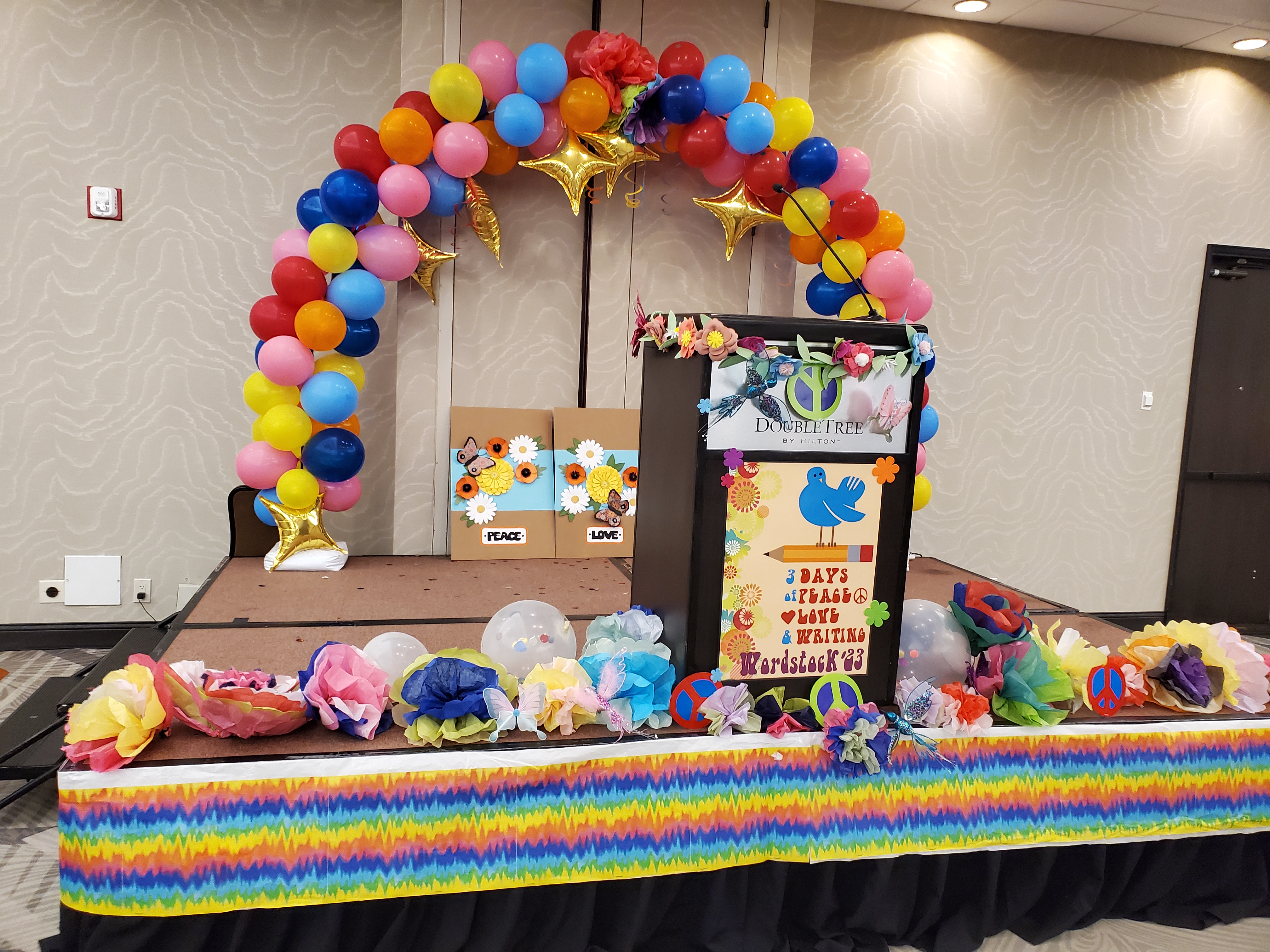
Pikes Peak Writers just finished up their 30th Annual Pikes Peak Writers Conference. The theme was Wordstock ’23, 3 Days of Peace, Love, and Writing. As president, it was my job to shake hands and kiss puppies. By puppies, I mean the wonderful Oski, faithful companion and service dog to Chris Mandeville, but I digress already (easily distracted by books and dogs). I had the freedom to roam the whole conference area, attend whatever workshops I wanted, and run errands throughout the hotel for my fellow volunteers working the conference along with talking with conference attendees.

A whole lot of volunteers are required to put the PPW conference on, including our conference director, Jenny Kate, our MC, Bowen Gillings, our programming director Karen Fox, our bookstore manager, Laura Hayden (second in command, James Knight), our registrar, Charise Simpson, our sponsor coordinator Nikia Hunt, our pitch coordinator Cara Allen, our webmaster, Sharon Manislovich, our wonderful and talented ballroom coordinator and creator of our theme, Rebecca Glesener Davis (aren’t these decorations just groovy?), and so many more. I wish I could name everyone, but that would make this post very long. Thanks to all the volunteers that helped make this conference possible, including those that just jumped in and helped out at the spur of the moment.

Me, Rebecca Glesener Davis, and Sharon Manislovich.

I talked to PPW members, non-members, agents, editors, and writers of every level from novice, to hobby, to indie, to traditionally published. This post is aimed at those that are newer to the writing game, writers conferences, and what to do after drinking from the fire hose that is a writers conference.

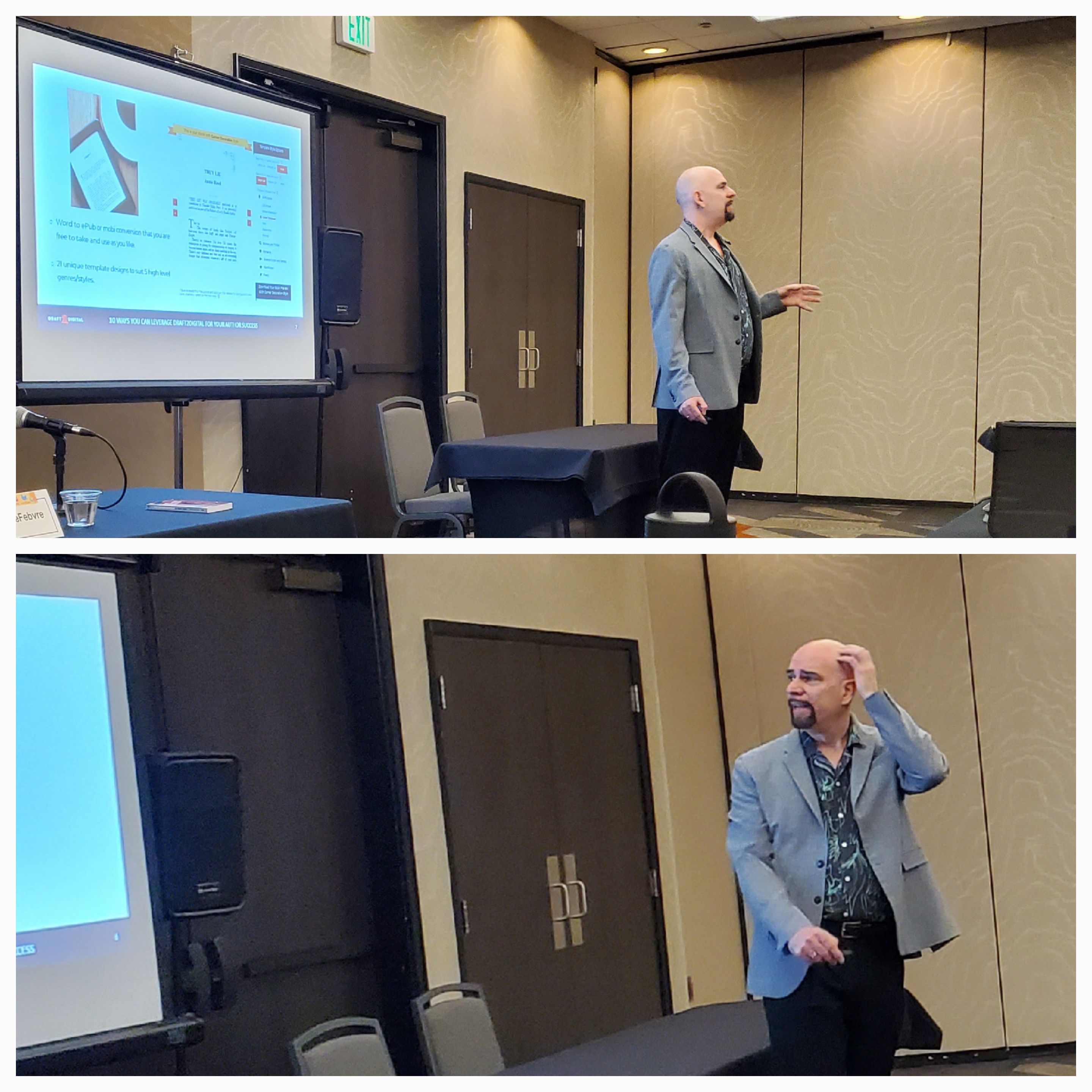
The ever informative and entertaining Mark Leslie Lefebvre!
  1. Use the momentum of conference to your advantage. Use your enthusiasm to write that blog post, create a writing schedule, make your writing space as inviting to your process as possible, create an exercise routine, or, ya know, get words on the page. You can use the high energy of conference to help you for days, even a week after conference, which can help you begin to create good habits.
  2. I take copious notes while at conference. My brain fog and memory issues have intensified after having Covid and my notes are more important than ever. My notes include everything from room numbers to notes from talking with other writers and the people that help us get our books into the hands of readers such as the wonderful Mark Leslie Lefebvre, director of business development at Draft2Digital. Who is both informative and entertaining and kindly gave me a whole lot of information about publishing anthologies with D2D. Prioritize your notes you took and take action on them starting with the most important. Add those book recommendations to your TBR pile, send a thank you note to those that helped you out, follow up with those you wanted to meet up with outside of conference. BUT don’t be an obnoxious stalker. Don’t send pages to anyone that didn’t specifically ask for them. Don’t add anyone to your mailing list that didn’t give you permission to do so. Don’t ask for favors unless you’re ready to return them. Don’t try to sell anybody anything.
  3. Once you’ve got the post-conference work out of the way, it’s time for some pampering. Celebrate in whatever way your little writer heart loves.
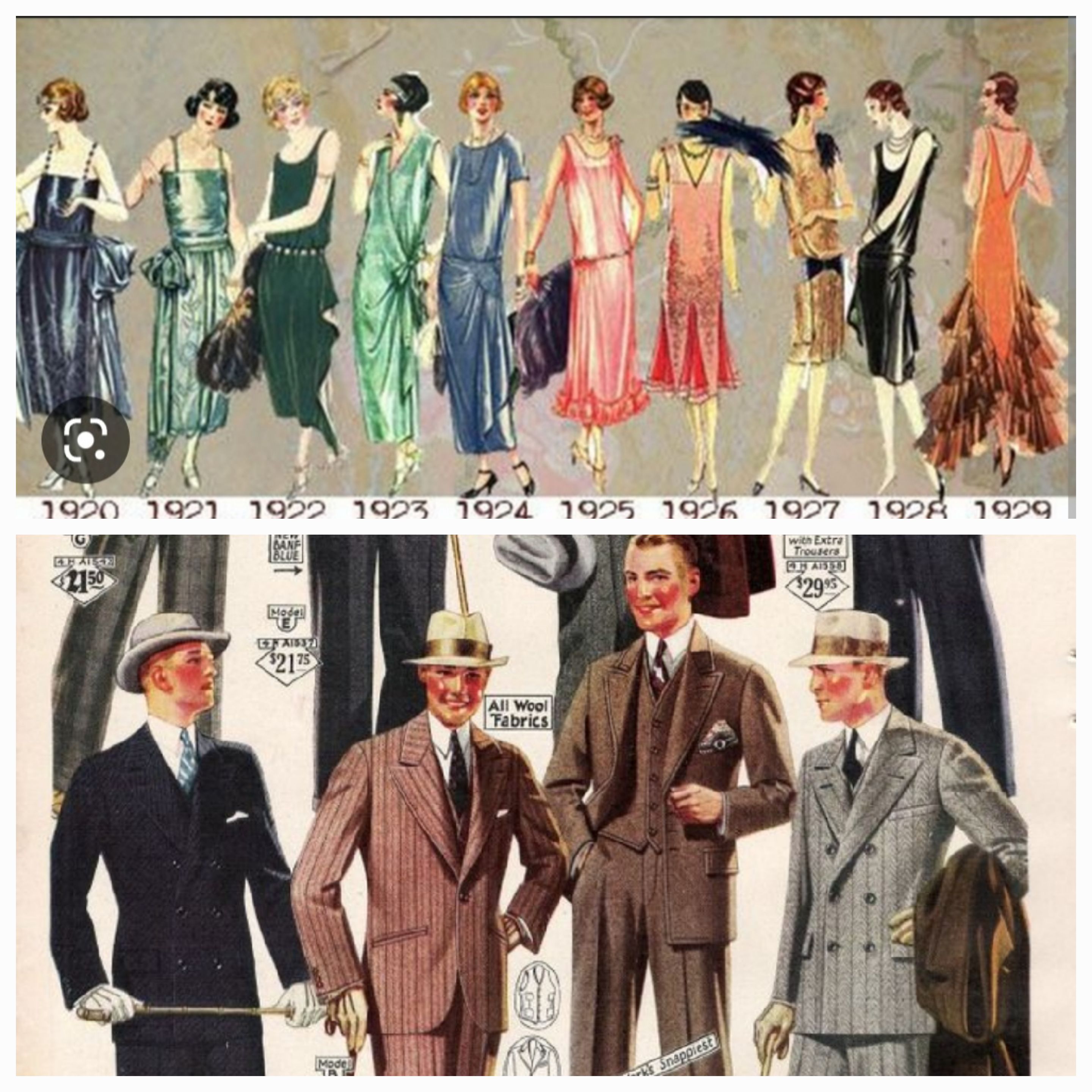
  4. Get writing! I want to see your book in the bookstore next to mine next year when YOU attend Pikes Peak Writers Conference 2024! You can get a friends of Pikes Peak Writers discount until the end of May. Pull out your flapper dresses, fedoras & channel your inner Gatsby! Check it out!
  5. Questions: What’s the first thing you do when you get home from conference? What do you miss the most about conference and how do you hold onto that until next time?
Hancock Historical Museum men’s and women’s fashion in the 1920s

Dear Writer, You Need a Hobby

Stephen King does jigsaw puzzles, plays guitar, and bowls. Emily Dickenson loved baking. Agatha Christie traveled with her husband. E. Cummings painted. Jackie Collins is into soul music and photography.

Hobbies. Every writer could use one or two.

“Why would I need a hobby? Don’t I have enough to do as a writer?” You may ask.

While writers do have full schedules (surprisingly, “other” people do too), spending time on a hobby can be beneficial in many ways.

  1. Certain hobbies help keep you healthy. Stephen King is among may writers who have been known to take a daily walk. Here in Colorado many writers have outdoor hobbies such as hiking, biking, running, paddle boarding, skiing, and much more. Physical hobbies help your body release feel-good chemicals in your brain and rid your body of toxins, helps you focus better, and sleep better, and that helps you write better. Plus, expending energy on physical hobbies, actually gives you more energy for everything else, including writing. Many times, these hobbies are combined with other hobbies like photography or camping.
  2. I used to help out one of my hubby’s former employers with tagging merchandise. It sounds monotonous, poking those little plastic things with a tag through item after item, case after case of…stuff. Sounds downright mind-numbing right? Wrong! I had some of my most creative ideas when I was doing this work. Why? Because my inner critic was focused on doing the job and not poking myself with the tagging gun, which left my imagination unsupervised and free to make up whatever it wanted to. The same goes for seemingly repetitive hobbies like knitting or crocheting. These hobbies allow the mind to unwind and stretch out.
  3. You need to get out among the people sometimes. Yes. I said it. You have to go OUT. Look, you can’t make good stories in a vacuum. If you’re not getting out once in a while, you’re missing the opportunity to gather valuable story fodder. Hobbies like spectator sports, joining a park and recreation softball league, a dart league, or just walking the mall make you get out amongst your fellow humans and help to remind you of how people act, for better or worse.
  4. Hobbies help fill the well. When I’m relaxing with my hubby on the sofa watching TV and crocheting, just chilling, I’m filling the well. When I’m walking my dog or playing ball with her in the back yard, I’m refilling the well. When I’m chilling with a good book that I’m reading just for fun (yes, you should do this too), I’m refilling the well. Do whatever refills your well. Do it regularly. This is one of the most important things writers can do for themselves.
  5. Finally, hobbies can help you overcome your writing problems. Have a sticky plot problem? Take a walk or play the guitar. Trying to figure out how best to get those love interests together? Go hang out at the mall and people watch the couples (but don’t be creepy about it, no one wants to be that person). Feeling stuck? Bake something, even if it’s cookies out of the refrigerated section at the grocery store, so that you can feel like you’ve accomplished something when you take the final product out of the oven.

So, my writer friends, if you haven’t already picked up the thing that helps you unwind or helps you get inspired, fear not! There are tons of things to do. Some of the writer I know do things like:

Photography

Hiking

Crochet

Video Games

Cooking

Reading (for pleasure)

Movies

Music

Playing and instrument

Drawing

Knitting

Painting

Puzzles

Camping

Board games

Role playing games

Make jewelry

Quilling

Calligraphy

Sewing

Needlepoint

Volunteer work

And many more! Think about what interests you and Google from there. The possibilities are seemingly endless.

Relax and write on my writerly friends.

Previously published on Writing from the Peak, the Pikes Peak Writers blog.