Just joining the series? You can start with post one, here.
We have come to the end of this series on using the Law of Attraction in your writing life. The final lessons is simply this:
The most powerful LOA secret is to act as if you are already the writer you dream of being.
Embody the writer identity you want today: write regularly, submit your work, and treat yourself as a published author in mindset. LOA responds when you live as your future self. Perfectionism is irrelevant and unattainable, but growth happens in the process. It’s that process that will propel you toward your goals.
Try This: Set a small “writer identity” challenge: write 500 words today, or query one agent. Feel your energy and the energy around you change as you step fully into that role.
You are already the writer you aspire to be. LOA is a tool that helps you step fully into that reality.
Wishing you the best on your writing journey. Feel free to share you thoughts in the comments.
Just joining the series? You can start with post one, here.
Many authors credit visualization, affirmations, and mindset for their success. They didn’t just dream — they aligned their actions with their beliefs.
Examples: Stephen King impaled all of his rejection letters on an iron nail he drove into a wall, which soon became an iron spike. This visual motivated him to keep going and made him into the prolific best-selling author he is today.
Jim Carrey, actor and comedian famously wrote himself a check for $10 million for “acting services rendered” early in his career, visualizing himself receiving that sum years before it actually happened for his role in Dumb and Dumber.
LOA isn’t wishful thinking; it’s a practice of living in alignment with your goals, but don’t take my word for it.
Try this: Find and research one author whose success story inspires you. Identify the mindset strategies they used and adopt one for your own writing.
It worked for them, it can work for you — with aligned action. Tell us about what you found and how you’re going to use it in your own writing life. Sharing is caring. A rising tide raises all boats…and all that sort of thing. Let’s do this!
Just joining the series? You can start with post one, here.
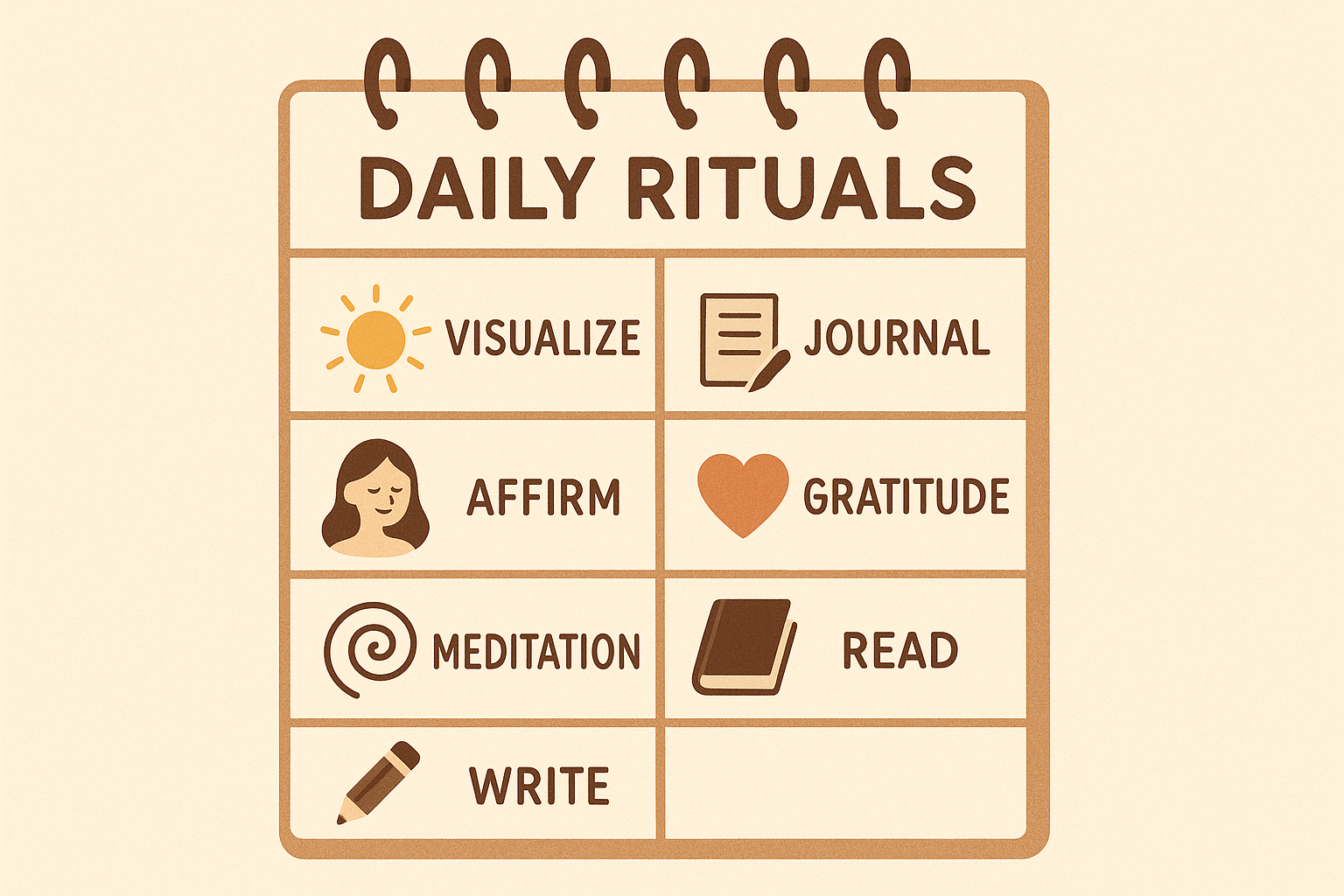
Morning visualization, affirmations, gratitude; writing intention; evening reflection. Consistency builds momentum, but consistency doesn’t have to be grueling. No routine, no matter how well designed, is going to work for you if you don’t do it. It’s important that you tailor any routines to you and your life so they can work for you.
Try This: Design a 10-minute LOA routine 2 min gratitude – example: I’m grateful for the great ideas I get for my stories. 3 min visualization – example: Visualize your perfect writing day. Where, when, and how with details. 5 min affirmations – example: I write good stories worth publishing. Readers love reading my stories.
Remember, these items don’t have to be fancy. The important thing is that they make you feel something that reinforces your resolve and supports your process. They should resonate with you and when they stop resonating, it’s time to lean in and find out why and where your current course is taking you.
Daily LOA primes writing for success. When you practice the steps you can’t fail. Even failure itself is a victory because you’ve learned about what you don’t want. Share your 10-minute LOA routine in the comments. I’d love to hear about it and you could help others who feel stuck.
Just joining the series? You can start with post one, here.
Scarcity thinking stunts creativity. Celebrate other writers, see competition as collaboration, trust your voice. Scarcity thinking is fear. It’s also a common advertising tool, triggering scarcity thinking of FOMO (fear of missing out) by using phrases like “limited availability”, “only a limited number of (insert item here) available”. Sometimes it’s actually true. Remember the Law of Attraction, what you think about is what shows up in your world. If you’re thinking about what you’re lacking, what other people have that you don’t, you’ll attract more of that scarcity.
Try This instead: Note one thing you admire in another writer daily.
An abundance mindset sustains joy and attracts opportunities. Focus on what’s going right. Follow that, and watch abundance flow to you. I’d love to hear how this step works for you. Post your experience below. You might help others, too.
If you just joining the series, you can start from post one here.
Here’s where the rubber starts meeting the road, so to speak. Where you begin to put together the tools you’ve learned so far to manifest your writerly dreams. As such, I’m going to go into a little more detail than you’ve seen so far. Right-O, let’s start with some exercises. Pick one to work on that makes sense for where you are in with your writing project.
Try This:
1. The Visualization & Embodiment Exercise: “My Launch Day” Purpose: Align emotionally and energetically with the experience of being a published author.
How to do it: Sit somewhere quiet, close your eyes, and take a few deep breaths. Imagine your launch day as vividly as possible: You’re holding your book in your hands. You see readers’ posts online celebrating your release. You smell the fresh pages and feel the excitement in your body.
Anchor that feeling — joy, pride, gratitude — and repeat silently: “This is my reality now. My words are out in the world.”
Write down a few sensory details afterward (“The book felt warm in my hands,” “The bookstore lights were bright and inviting”).
Why it works: Your subconscious mind starts aligning your thoughts, emotions, and behaviors with that version of yourself.
2. Scripting Exercise: “My Book is Out There” Purpose: Use journaling as an energetic pre-order for your publishing success.
How to do it: Write a journal entry as if your publishing dream has already happened.
Example prompts: “I can’t believe I’m holding my finished book — it looks even better than I imagined.” “My publisher emailed to say early reviews are glowing!” “Readers are connecting deeply with my story.”
Add emotion and gratitude throughout — write from the feeling of it being real, not just about it.
Why it works: Writing from the end state sends a clear, emotional signal to the universe of what you’re calling in — and keeps your belief steady.
3. Alignment in Action: “Inspired Submissions” Purpose: Pair belief with tangible, aligned action.
How to do it: Before submitting a query, self-publishing your book, or sharing a sample, center yourself with this intention: “The right opportunities are drawn to my words with ease.”
Visualize your query letter or upload glowing with golden light — imagine it landing exactly where it belongs. Take the action with confidence and release the outcome.
Afterward, write a gratitude statement like: “I’m grateful for every opportunity that moves me closer to publication.”
Why it works: LOA amplifies results when belief meets motion. You’re signaling to the universe that you’re ready and aligned — not waiting.
LOA transforms publishing into inevitable when paired with action. Take one publishing action today with visualization. Use and/or change it up as you move forward. Share in the comments for others who might be stumped. I’d love to hear how this works out for you.
Sorry to be late this week, guys. Let’s get into it. The law of Attraction teaches that what you’re open to, you receive. Trying to force ideas often backfires. Instead, create an environment where inspiration flows naturally. Quiet meditation, walks in nature, or freewriting exercises clear blocks.
Examples:
Keep an “idea notebook” for sparks that come unexpectedly.
Use freewriting to release pressure and allow ideas to surface.
Exercise: Take a 10-minute walk outside and jot down the first 5 ideas that pop into your head. Don’t judge them — just receive.
Takeaway: When you shift from chasing to receiving, ideas come effortlessly.
Gratitude is a powerful magnet — what you appreciate multiplies.
Daily gratitude shifts focus from lack to abundance. In writing, this means acknowledging small victories: finishing a paragraph, learning from edits, or submitting a query. Gratitude keeps momentum alive even when the road is long and can help you keep things in perspective when frustration sets in.
Something like:
“I’m grateful I wrote 500 words today.”
“I appreciate the feedback from my critique group.”
“I’m grateful for my writing community.”
“I’m grateful for the creativity I’ve been gifted.”
Try This: Keep a daily gratitude journal just for writing. If you already keep a writing journal, you can incorporate gratitude there. If you don’t, start a new journal to fill with gratitude. What writer would turn down the opportunity to buy yet another notebook? Not me! List 3 things every day that you’re thankful for, no matter how small and take a moment to really feel it. Feel the warm glow that gratitude ignites within you. Notice how it changes your energy. At the end of the year, flip through your gratitude journal and let the positive energy there energize you for the next year. Notice where you may have just been going through the motions and where you can plainly see you were truly and deeply grateful.
Gratitude isn’t passive reflection — it fuels creativity and resilience. Feel free to share some of your gratitude entries in the comments. I’ll bet there are others with similar entries!
Imposter syndrome is every writer’s shadow. Self doubt is always just a thought away. Affirmations shine a light on the path forward. It’s not just woo-woo stuff. Affirmations are more than motivational phrases — they are tools for rewiring your beliefs. Repeating empowering statements primes your subconscious to accept them as truth.
Something like:
“I am a creative channel; stories flow through me effortlessly.”
“Readers are waiting for my words.”
“Opportunities for publication come to me naturally.”
Try this: Write 3 personalized affirmations for yourself. Repeat them each morning and before writing sessions for thirty days. Feel the words as if they are already true and visualize what that would look like in detail. At the end of the thirty days, evaluate how these affirmation landed and whether they were effective. You may have to make adjustments to get the wording just right for you. Remember the universe is waiting for your command so it can bring it to you as fast as possible.
The stories you tell yourself set the stage for the stories you create. The choice is, and always has been, yours. There’s no such thing as “writer’s block” only blockages of flow, which affirmations can help you remove. Share your affirmations in the comments. Maybe you might have the magic spark that helps someone else get into creative flow.
Every bestselling novel began as an idea in someone’s mind. Many people don’t get beyond the idea. Your writing career can begin the same way but better — with clarity and visualization.
Let’s take a look at the numbers. The odds of you finishing the writing of and publishing you book are often quoted as follows:
Only 3% of people who set out to write a novel actually finish a novel. To put that into context, the USA (pop 332M) is about 4% the population of the world (8B).
Less than 0.1% of people ever write a book, so we’re down from a worldwide population of 8B to 8M. That’s equivalent to New York City. It’s still a lot of people, but think of it like this: in the entire world, 7,992,000,000 will never write a single book.
The odds of getting a book traditionally published is around 1-2%.
The average traditionally published book sells around 3,000 copies over its lifetime, and less than 500 the first year.
A PUBLISHER breaks even on a $10,000 advance by selling around 1,000 copies. There are a lot of variables at play here, but an AUTHOR earns out on a $10,000 advance by selling more than 5,000 copies. Less than 25% of books “earn out” their advance.
What about best sellers? These numbers are clouded in secrecy but one estimation is that a book has to sell at least 10,000 copies during the FIRST WEEK to even have a shot at the NYT Best Seller list. Something like 0.08% of books published in the US annually (300,000) make the US Best Seller lists. To break this down, you have a better chance of winning the lotto (1 in 300M) and being struck by lightning twice (1 in 9M) than writing a book, getting it traditionally published, and making the Best Sellers list.
Sound discouraging? It shouldn’t. If you’ve finished a book you may already be in an elite class of only 3% of all the people who start a novel and actually finish it. If you’ve been traditionally published you may already be breathing even more rarified air.
Even so, almost any author will tell you that every book feels like writing for the first time. Many of us call it “imposter syndrome”. This is where visualization comes in. Visualization is mental rehearsal. When you picture your ideal writing life, your mind treats it as reality, preparing you for opportunities and because your mind treats all input as true, negative visualizations can bring negative influences, let these pass on by. They’re not for you.
There’s lots of ways to use visualization to create a writing life to help you succeed.
You can use: A vision board Journal prompts Mantras Meditations (guided or your own) And more, find what works for you at this time
Try This: picture yourself at a writing retreat picture yourself opening a shipping box and holding your published book imagine you’re doing a wildly successful book signing event Imagine readers and fans reacting positively to your work Imagine yourself as a best-selling author
Make your visualizations as detailed and vivid as possible. What are you teaching at the writing retreat? Who are you be hanging out with? Look at your hands note every detail then imagine them holding your book. Whose familiar faces do you see at your book signing cheering you on? FEEL the feeling of seeing that best seller tag on your book on Amazon, or the writeup about your best-selling book on Publishers Weekly.
Exercise: Create a mini or digital vision board using magazine cutouts, Pinterest, or sketches. Include writing spaces, book covers, and images that represent the lifestyle you want. If you make the digital version, use the image as the wallpaper on your laptop or desktop.
When you clearly see your destination, the universe speeds towards you with what you need and desire to move you to your desired destination. You’ll notice new people who bring knowledge you need, events that put you on the path to your dreams and in the path of people who will be instrumental in your success; your vision board coming to life. Comment below about how you’re using visualization in your life.
The Law of Attraction for Writers — What It Is and Why It Matters
Many writers dream of seeing their name on a book cover, signing copies, finishing a manuscript, maybe even becoming a speaker. but doubt creeps in. What if the secret to manifesting that dream isn’t just hard work but aligning your mindset first? What would happen if you expected these things instead of dreaming of them?
The Law of Attraction (LOA) teaches that what you focus on expands. That means your thoughts, beliefs, and feelings influence the opportunities and creativity that flow into your life. In writing, LOA isn’t about wishful thinking — it’s about consciously shaping your mindset to create real results.
Examples Include:
Daydreaming a successful book launch primes your brain to recognize opportunities.
Positive self-talk like “I am capable of finishing this story” increases productivity.
Opening to letting the higher power, universe, or random parts of reality lining up.
Knowing that success is working hard to find you.
Try this: Spend five minutes today writing down one scene you imagine finishing perfectly. Feel the satisfaction as if it’s real.
Your writing life starts in your mind. Master it there, and reality follows.
This is the first installment in a ten-part series of short, actionable things you can do to create a mindset that can help you achieve the writing life you’ve dreamed of. Each Monday a new post will drop with a new focus and a new lesson in positive flow for writers.







 K.A. Olgren Stories 'n' More